
You’ve seen the terms thrown around interchangeably a hundred times. A headline screams “AI is taking over,” a LinkedIn post brags about a “machine learning breakthrough,” and a tech reviewer casually mentions “deep learning” like everyone in the room already knows exactly what that means. Nobody stops to explain the difference and honestly, most people using these words don’t fully know it either.
Here’s the thing that trips people up: these three terms aren’t three different technologies competing for your attention. They’re nested inside each other, like Russian dolls. Once you see the shape of that relationship, the confusion mostly disappears. And once it disappears, you’ll start noticing when companies are using “AI” as a marketing buzzword for something that’s really just a basic spreadsheet formula which happens more often than you’d think.
This guide is going to walk you through exactly where each term starts and ends, why the distinctions actually matter, and how to spot which one is really being used the next time someone name-drops “AI” in a sales pitch.
Table of Contents
- The Russian Doll Problem Why These Terms Get Confused
- Artificial Intelligence: The Big Umbrella
- Machine Learning: Teaching Machines Through Examples
- Deep Learning: Machine Learning’s Most Powerful Subset
- Putting Them Side by Side
- Real World Examples of Each
- Why the Difference Actually Matters
- Common Misconceptions That Confuse Everyone
- How to Spot Buzzword Misuse
- The Bottom Line
The Russian Doll Problem Why These Terms Get Confused
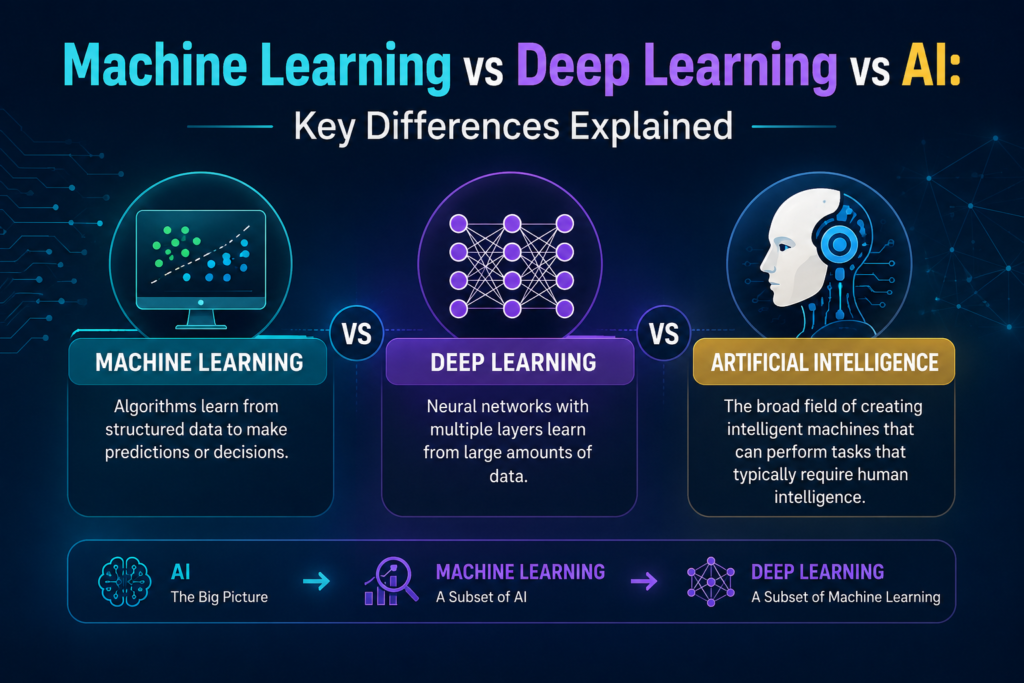
Picture three circles. The biggest one is Artificial Intelligence. Inside that circle sits a smaller one called Machine Learning. And inside that one sits an even smaller circle called Deep Learning.
That’s really the whole relationship in one image. AI is the broad goal building machines that can perform tasks requiring human-like intelligence. Machine learning is one particular approach to reaching that goal, where systems learn from data rather than being explicitly programmed. And deep learning is a more specialized, more powerful technique within machine learning, built around structures called neural networks.
The confusion happens because all three terms describe things that can look identical from the outside. A chatbot that answers your questions, a system that recommends a show, a tool that spots a tumor on a scan any of these could be running on classic AI rule-based logic, plain machine learning, or deep learning. You genuinely can’t tell just by watching it work. You have to look under the hood.
So let’s do that, one layer at a time.
Artificial Intelligence: The Big Umbrella
Artificial intelligence is the broadest category it refers to any technique that allows a computer to mimic human intelligence, whether that’s reasoning, problem-solving, understanding language, or recognizing patterns.
Here’s something that surprises a lot of people: AI existed long before machine learning became dominant. Early AI systems, going back to the 1950s and 60s, were built on hand-coded rules. A programmer would sit down and write out logic like: “if the patient has a fever above 101 and a persistent cough, flag for possible flu.” That’s AI. It’s just not learning anything it’s following instructions a human explicitly wrote.
This is called symbolic AI, or “good old-fashioned AI” among researchers, and it’s still used today for things like tax software, certain chess engines, and rules-based fraud alerts. It’s rigid, but it’s also predictable and explainable, which matters a lot in fields like law and finance, where “the algorithm just felt like it” isn’t an acceptable answer.
The problem with rule-based AI is obvious once you think about it: you can’t write a rule for every possible situation. Language, images, and human behavior are far too messy and varied. You’d need millions of rules to cover every way a sentence could be phrased or a face could look, and even then, you’d miss things. That limitation is exactly why machine learning emerged as a better path forward for a lot of AI applications.
So, the short version: AI is the destination. Rule-based logic and machine learning are two very different roads that can both get you there.
Machine Learning: Teaching Machines Through Examples
Machine learning flips the old approach on its head. Instead of a programmer writing explicit rules, you feed the system a large number of examples, and it works out the patterns on its own.
Think about how a real estate agent with fifteen years of experience can glance at a house and give a surprisingly accurate price estimate without doing a single formal calculation. They’ve simply seen thousands of homes sell over the years, and their brain has quietly absorbed the patterns square footage, location, school district, condition into an intuitive sense of value. Machine learning does something structurally similar, except instead of fifteen years of experience, it might process millions of data points in an afternoon.
There are three broad ways machine learning systems learn:
Supervised learning is the most common, where the system is trained on labeled data meaning each example comes with the “correct answer” attached. Show it ten thousand emails labeled “spam” or “not spam,” and it learns to make that call on new emails it’s never seen. This is how most fraud detection, credit scoring, and email filtering systems work.
Unsupervised learning works without labels. The system is just handed a pile of data and asked to find structure in it on its own grouping customers into segments based on shopping behavior, for instance, without anyone telling it what the segments should be beforehand. This is how a retailer might discover a customer group they didn’t even know existed.
Reinforcement learning works more like training a dog. The system takes an action, gets a reward or penalty depending on the outcome, and adjusts its behavior over time to maximize reward. This is the technique behind AI that plays video games at a superhuman level, and it’s also used in robotics and some trading algorithms.
Machine learning was genuinely revolutionary because it meant systems could improve with more data, without a human rewriting the code every time. But and this matters classic machine learning still typically needs a human to decide which features of the data actually matter. If you’re building a system to predict house prices, a person still has to tell the model “pay attention to square footage, bedrooms, and location.” That manual step is called feature engineering, and it’s exactly the limitation that deep learning was built to overcome.
Deep Learning: Machine Learning’s Most Powerful Subset
Deep learning is a specific type of machine learning that uses structures called neural networks, loosely inspired by how neurons connect in the human brain. The word “deep” refers to the number of layers in the network the more layers, the “deeper” the model.
Here’s the key difference that separates deep learning from classic machine learning: it doesn’t need a human to point out which features matter. Give a deep learning model enough raw images of cats, and it will figure out on its own through layer after layer of processing that whiskers, pointed ears, and a certain body shape are relevant features. Nobody programs that in. Early layers of the network might just detect edges and contrast. The next layers combine those into shapes. Deeper layers still combine those shapes into recognizable objects. It’s an automatic, self-organizing hierarchy of pattern recognition.
This is exactly why deep learning is behind the AI breakthroughs that actually made headlines over the last decade image recognition good enough to diagnose disease from scans, voice assistants that understand natural speech, real-time language translation, self-driving car vision systems, and large language models like the ones powering today’s chatbots.
The tradeoff is real, though. Deep learning models typically require enormous amounts of data and computing power to train we’re talking thousands of specialized processors running for weeks, consuming serious electricity in the process. And there’s a well-known transparency problem: even the engineers who build these models often can’t fully explain why the model made a specific decision. It’s sometimes called the “black box” problem, and it’s a genuinely active concern in fields like healthcare and lending, where being able to explain a decision isn’t optional it’s often a legal requirement.
So deep learning isn’t simply “better” machine learning. It’s a more powerful, more data-hungry, less transparent tool that happens to be extraordinarily good at a specific class of problems particularly ones involving images, sound, and language.
Putting Them Side by Side
If you strip away the jargon, here’s the practical distinction that actually matters day to day:
- AI is the goal: machines performing tasks that would normally require human intelligence.
- Machine learning is a method for reaching that goal: systems that improve by learning from data instead of following hand-written rules.
- Deep learning is a more advanced method within machine learning: systems using layered neural networks that can learn relevant patterns automatically, without a human pointing them out.
A useful way to remember the scale: not all AI is machine learning (that old rule-based tax software is AI but not ML). Not all machine learning is deep learning (a basic spam filter is ML, but it’s not running a neural network with fifty layers). But all deep learning is both machine learning and AI. The circles really do nest inside each other cleanly — it’s one of the rare cases in tech where the simple explanation is also the accurate one.
Real World Examples of Each
Abstract definitions only get you so far, so let’s ground this in things you’ve probably actually encountered.
Rule-based AI in the wild: Older customer service phone trees “press 1 for billing, press 2 for support” — are a form of AI, but a very rigid one, built entirely on pre-written logic trees with zero learning involved. Basic thermostat systems and older-generation antivirus software, flagging files based on a known list of virus signatures, work the same way.
Machine learning in the wild: Your bank’s fraud detection system is a great example. It’s trained on years of transaction data, learning what a normal spending pattern looks like for you specifically, and flags anything that deviates sharply a $2,000 purchase in a country you’ve never visited, for instance. Netflix’s early recommendation engine also ran largely on classic machine learning, analyzing viewing patterns across millions of users to group you with people who have similar taste.
Deep learning in the wild: Voice assistants like Siri and Alexa rely heavily on deep learning to convert your spoken words into text and understand intent, a task involving nuance and variation that rule-based systems could never handle well. Medical imaging tools that flag potential tumors in X-rays or MRIs typically use deep learning, trained on hundreds of thousands of labeled scans. And large language models the technology behind ChatGPT, Claude, and similar tools are a deep learning application at a massive scale, trained on enormous volumes of text to predict language patterns with startling fluency.
One instructive case study: in 2012, a deep learning model called AlexNet competed in an annual image recognition competition and dramatically outperformed every rule-based and classic machine learning approach that had come before it, cutting the error rate almost in half compared to the next best system. That single event is widely credited with kicking off the modern deep learning boom it proved, in a very public and measurable way, that this approach wasn’t just theoretically interesting, it was practically superior for an entire category of problems.
Why the Difference Actually Matters
This isn’t just semantic nitpicking. Understanding which technology is actually being used has real, practical consequences.
For businesses making tech decisions: deep learning is powerful, but it’s also expensive, data-hungry, and harder to explain. A small business trying to predict next month’s inventory needs probably doesn’t need a neural network — a much simpler machine learning model, or even a well-built spreadsheet formula, will do the job faster, cheaper, and more transparently. Choosing deep learning because it sounds impressive, rather than because the problem actually requires it, is a surprisingly common and costly mistake.
For regulation and accountability: if a bank denies you a loan, in both the US and UK there are growing legal expectations that the institution can explain why. A simple, rule-based or classic machine learning model can usually produce that explanation clearly. A deep learning model, with its black-box tendencies, often can’t which is part of why regulated industries are sometimes slower to adopt the flashiest AI techniques, and why “explainable AI” has become its own dedicated research field.
For evaluating hype: when a startup claims its product is “powered by advanced AI,” that phrase alone tells you almost nothing. It could mean a sophisticated deep learning system trained on millions of examples, or it could mean a handful of if-then rules dressed up in marketing language. Knowing the distinctions in this article gives you the ability to ask sharper questions “is this rule-based, or does it actually learn from new data?” instead of just nodding along.
For your own career and skill-building: if you’re considering a move into tech, data analysis, or any AI-adjacent field, these aren’t just vocabulary words they represent genuinely different skill sets and career paths. Classic machine learning roles often lean on statistics and structured data. Deep learning roles increasingly involve specialized tools, heavier computing infrastructure, and a different kind of technical depth. Knowing which lane interests you actually matters for where you point your learning.
Common Misconceptions That Confuse Everyone

“Deep learning is just a fancier, better version of machine learning.” Not quite. It’s a subset with real strengths and real weaknesses. For small, structured datasets say, predicting employee turnover from HR records — classic machine learning frequently outperforms deep learning, which tends to need vastly more data to shine.
“AI, ML, and deep learning are basically the same thing.” As covered above, they’re nested, not identical. Using them interchangeably is like using “vehicle,” “car,” and “electric car” interchangeably. Technically related, but not remotely the same claim.
“If it’s not deep learning, it’s not real AI.” This one shows up a lot in casual conversation, and it’s just wrong. Rule-based systems and classic machine learning are both legitimate, well-established forms of AI they’re just less trendy to talk about than the neural network-powered tools making headlines right now.
“More layers in a neural network always means a better result.” Deeper isn’t automatically better. Beyond a certain point, additional layers can lead to a model that’s overfit meaning it’s memorized quirks of its training data rather than learned generalizable patterns or one that’s simply too computationally expensive to justify its marginal improvement.
How to Spot Buzzword Misuse
Next time you see “AI-powered” slapped on a product description, here’s a quick mental checklist to cut through the noise:
Ask whether the system improves with more data over time, or whether it behaves identically no matter how much you use it. If it’s static, you’re likely looking at rule-based logic, not learning.
Ask whether the task involves messy, unstructured input images, natural speech, free-form text. If so, there’s a decent chance deep learning is genuinely involved, since that’s exactly the category of problem it excels at.
Ask whether the company can explain, in plain language, what data trained the system and how it makes decisions. Vague answers are a mild red flag. Specific answers even complicated ones usually indicate there’s real substance behind the marketing.
None of this means you need to become a data scientist to use tech products wisely. It just means you can ask one or two sharper questions before believing a bold “AI-powered” claim at face value.
The Bottom Line
Artificial intelligence, machine learning, and deep learning aren’t three competing technologies they’re three layers of the same idea, each one a more specific, more powerful expression of the last. AI is the ambition. Machine learning is a method for getting there by learning from data instead of following rigid rules. Deep learning is the most advanced version of that method, capable of finding patterns in raw, messy information that older approaches simply couldn’t touch.
Understanding where each one starts and ends won’t just make you sound sharper at your next conversation about tech it’ll make you a genuinely better judge of the tools you use, the products you buy, and the claims companies make about both. The next time you hear “AI-powered” in a pitch, you’ll know exactly what question to ask next and that’s a small but real form of power in a world that’s only going to lean on these words more, not less.
Read More artificial Intelligence